
Organizers
Co-Convenors: Holly Ann Garnett (Royal Military College / Queen's University, Canada), Toby James (University of East Anglia, UK), Gabriela Tarouco (Federal University of Pernambuco, Brazil)
Conference Administrator: Sofia Caal-Lam (EIP, Project Coordinator)
Conference Assistant: Muhammed Topcu (Georgia State University, The Carter Center)
*This is a free conference
PRELIMINARY PROGRAMME
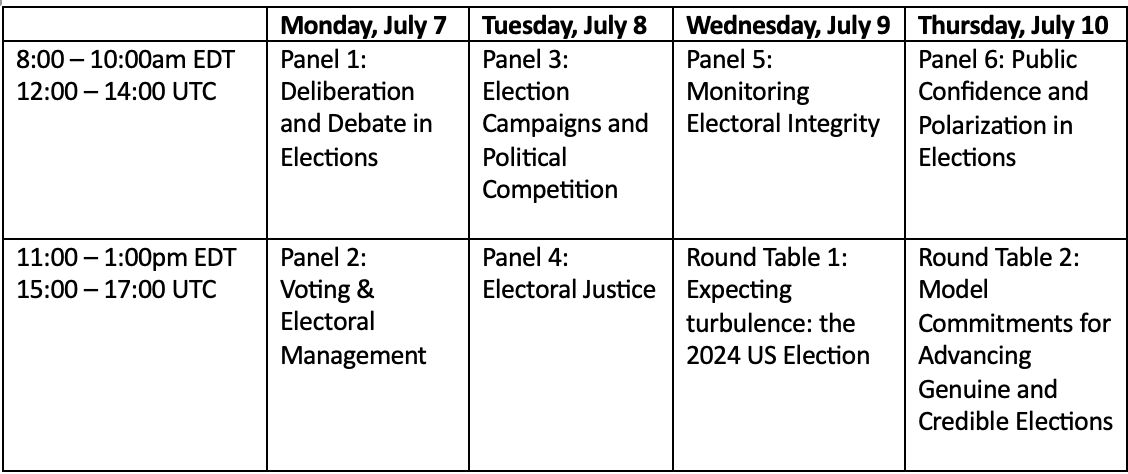
Panels will take place at 8am and 11am EDT / 12pm and 15pm UTC

Panel 1: Deliberation and Debate in Elections
Monday, July 7 at 8:00 AM (EDT)
Chair: Carla Luís (University of Coimbra)
Discussant: Robert G. Boatright (Clark University)
Rethinking disinformation as a form of electoral integrity – Ross Tapsell (The Australian National University) and Nicole Curato (Birmingham University)
The 2024 annulled Romanian presidential elections: weaponizing corruption narratives to grow distrust in the electoral system. A case study – Andreaa Gușă (University of Bucharest)
Freedom in the Fine Print: A Comparative Analysis of Expression Laws from Protection to Repression – Emily Adams (Georgia Institute of Technology), Sinisa Miric (Emory University), and Anthony DeMattee (Emory University)
Talk Matters - Deliberative Quality in Debates over Electing Indigenous Seats – Karen Bird (McMaster University), Abbey Forbes (McMaster University), Gloria Liu (McMaster University) and Maïa Rousseau (McMaster University)
Panel 2: Voting & Electoral Management
Monday, July 7 at 11:00 AM (EDT)
Chair: Emre Toros (Bilkent University)
Discussant: Leontine Loeber (Vrije Universiteit Amsterdam)
Electoral Bias and Democratic Backsliding: A Global Analysis – Bernard Tamas (Valdosta State University)
How Election Departments Can Reduce the Disruptions of Staff Turnover – David Levine (University of Maryland) and Kurt Sampsel (Pen America)
Bulwarks of Democracy? How the Independence of Electoral Management Bodies (EMBs) Shapes Democratic Resilience in Latin America – Alejandro González Ruíz (Notre Dame University)
The Impact of Natural Hazards on 2024 Elections - Erik Asplund (International IDEA)
Panel 3: Election Campaigns and
Political Competition
Tuesday, July 8 at 8:00 AM (EDT)
Chair: Thomas Mustillo (University of Notre Dame)
Discussant: Bernard Tamas (Valdosta State University)
Electoral Integrity and political competition: electoral processes in Mexico 2018-2024 – Irma Mendez (FLACSO Mexico) and Marietha Perez Arellano
Autocratic Advantage and Incumbency Advantage in Pandemic Elections: Assessing Evidence from Asia and Europe – Kenneth Ka Lok Chan (Hong Kong Baptist University)
Panel 4: Electoral Justice
Tuesday, July 8 at 11:00 AM (EDT)
Chair: Caroline Rodrigues Carlos (UNILA)
Discussant: Rodrigo Martins (Universidade de São Paulo)
Election Dispute Resolution: the case of the Netherlands – Leontine Loeber (Vrije Universiteit Amsterdam)
Judging the Ballot: Candidate Profiles and Electoral Court Decisions in Minas Gerais – Marjorie Marona (UNIRIO - Federal University of the State of Rio de Janeiro)
Judicial Ideology, Electoral Justice, and Campaign Finance: A Quantitative Analysis of Supreme Court Decision-Making (1947–2023) – Robert T.F. Downes (University of Connecticut)
Judicial Protection of Electoral Rights Between Fundamental Rights Protection and Objective Electoral Review – Maximilian Blassnig (University of Vienna)
Accessibility and Partisanship in Election Dispute Resolution – Joseph Klaver (University of Passau)
Panel 5: Monitoring Electoral Integrity
Wednesday, July 9 at 8:00 AM (EDT)
Chair: Rekai Rusinga (UC Davis)
Discussant: Richard Kweitsu (University of Florida)
Discussant: Lucas Damasceno Pereira (Universidade de São Paulo)
When Observers Become Targets: Russian Subversive Contestation within the OSCE – Markus Pollak (Central European University), Liliia Sablina (Central European University), and Mehmet Yavuz (University of Salzburg)
Cleaning the vote: the victory of electoral anticorruption social movements in Brazil – Andreia Carmo (Federal University of Pernambuco)
“It's a Small World! For 20 years, it's often been the same people!”: National Policing and Differentiated Transnationalization in the Field of OSCE Election Observation – Clément Desrumaux (Lumière University Lyon), Markus Pollak (Central European University), and Alioscha Massein (Centre National de la Recherche Scientifique)
Round Table 1: Expecting Turbulence:
the 2024 US Election
Wednesday, July 9 at 11:00 AM (EDT)
Chair and Discussant: Jeff Polet (Ford Leadership Forum)
Domestic Election Observation in the U.S. – Sarah Cooper (The Carter Center)
Strategic Litigation and Electoral Law – Chad Vickery (IFES)
Election Officials, Communication, and Social Media – Thessalia Merivaki (Georgetown University)
-
This panel focuses on the 2024 U.S. Presidential election and some of the key issues that arose before and after Election Day. With high stakes, the election practitioner community expressed concern over potential fraud allegations and even the risk of electoral violence. Although the most serious fears did not materialize, this electoral event offers a valuable opportunity to analyze how election officials, civil society initiatives, and political actors prepared for and promoted electoral integrity. The panel will review the Carter Center’s first domestic observation mission during a U.S. election, communication strategies used by election officials, and legal strategies related to electoral litigation.
Contact person: Ian Batista
Panel 6: Public Confidence and
Polarization in Elections
Thursday, July 10 at 8:00 AM (EDT)
Chair: Anna Mwaba (Smith College)
Discussant: Aleena Khan (University of Illinois at Urbana-Champaign)
Election Results and Democratic Discontent: Expectations, Extremism, and Democratic Values in Post-Election Brazil – Matteo Ferroni (University of Missouri)
Election Branding and Public Trust: The Role of Image in Shaping Voter Confidence – Anthony DeMattee (The Carter Center), Emily Carrillo (The Carter Center, Georgia Institute of Technology), Adee Weller (Emory University), Nicklas Stein (The Carter Center)
The disappearing middle: how polarisation makes credible elections harder to deliver – Sonali Campion (University of East Anglia)
Hacking Voters’ Trust in Democracy: Panel Evidence on Safeguarding Confidence in Election Integrity - Iris Ong (Georgia Institute of Technology)
Round Table 2: Model Commitments for Advancing Genuine and Credible Elections
Thursday, July 10 at 11:00 AM (EDT)
Chair and Discussant - Tova Wang (Harvard's Ash Center)
International Standards for Democratic elections – TCC and EOS – David Carroll (The Carter Center)
Model Commitments in the context of global norms-building – Therese Pearce-Laanela (International IDEA)
Elections and Democracy Support in the Changing International Climate – Pat Merloe
-
This panel will present and explore the Model Commitments for Advancing Genuine and Credible Elections document, a multi-organizational resource of actionable commitments that help improve, defend, and expand election integrity. Released in September 2024, the document provides specific steps government leaders and democracy advocates can take to help strengthen democracy and elections, including ways to expand dialogue on key electoral issues. The commitments draw on existing international norms, standards, and best practices for democratic elections but intend to move the field forward as democratic electoral processes face constant pressures and changing circumstances in countries around the world. The panel will provide an overview of the state of affairs of the international standards for democratic elections, expose the Model Commitments document and its areas of reach, and touch on an emerging and challenging new area in need of our common understanding.
Contact person: Chad Vickery
Theme
Elections are crucial to achieving democratic governance. We welcome workshop papers that fall into any of the following themes:
-
Elections should distribute power by allowing a wider range of groups, individuals and parties to contest the election. Papers are welcome on issues including (but not limited to): candidate selection, party dynamics, and electoral systems.
-
Elections provide a unique opportunity for deliberation on key policy issues. Papers are welcome on issues such as campaign finance, the information environment, and traditional and social media.
-
Wide and even participation is needed to ensure that the whole population has the power to direct and influence representation and policy. We invite papers that consider issues such as enfranchisement, accessibility, registration, voting methods, and voter turnout.
-
Electoral Justice provides an essential pathway for citizens, candidates, parties and other stakeholders to seek legal address where there have been defects in the delivery of elections. We welcome papers on topics on election monitoring, electoral justice, disputed elections and public trust.
Types of Paper
Papers are welcome from all disciplines, including but not limited to political science, law and legal studies, development and contemporary political history.
We take a pluralistic approach to research – and welcome papers from all types of research methods. This might include studies using narrative case-studies, process tracing, experimental designs, mass and expert panel surveys, systematic aggregate data, or political theory. Studies could be based on a single country or be cross-national in nature.
We also welcome practitioner papers which highlight recent policy innovations and other perspectives from the field of elections.
PRACTICAL LOGISTICS
Our fourth annual virtual conference will take place online, the week of July 8, 2025. Panels will be arranged to accommodate multiple time zones with panels taking place across the week.
As well as standard thematic paper panels with discussants, there will be practitioner and civil society roundtables and opportunities to connect with old/new colleagues and friends around the globe.
Conference registration will be free to all paper presenters and delegates.
All accepted paper-givers are asked to upload a copy of their written papers to the workshop website by 23 June, as a condition of inclusion in the program. This requirement allows discussants and all other participants to read work in advance, maximizing time and opportunities for feedback and discussion.